Low Risk. To Whom?

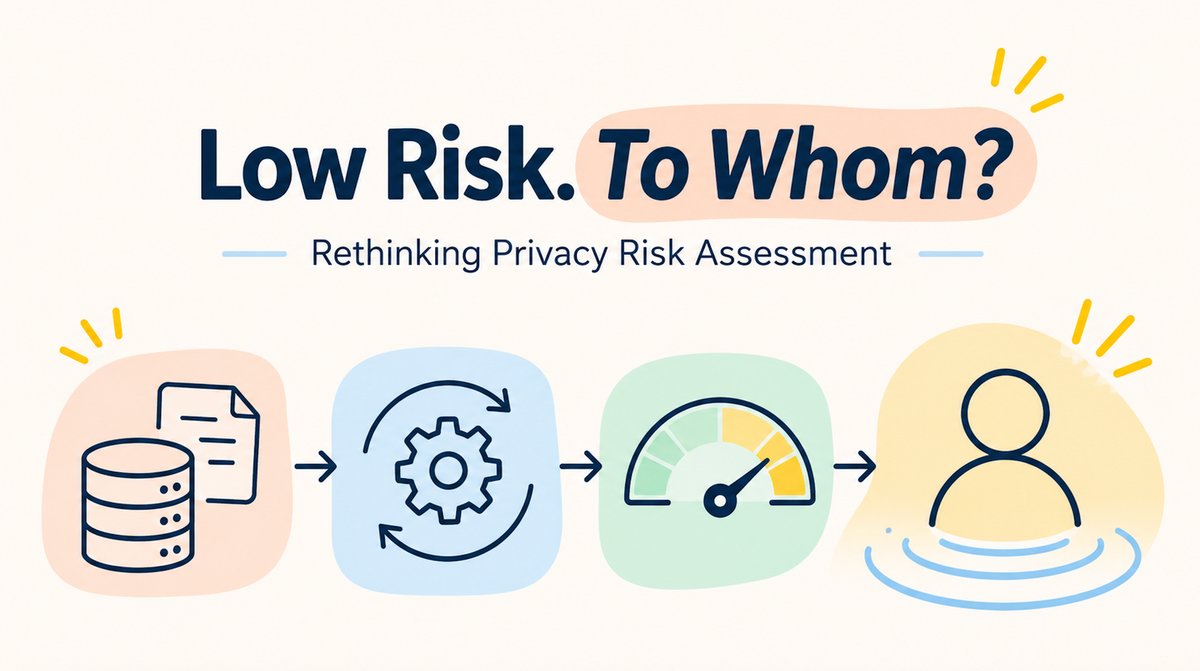
Rethinking Privacy Risk Assessment: When the system is secure, but the person is still at risk.
There is a question I have started asking myself more often when reviewing privacy risks.
Low risk. To whom?
To the organisation? To its systems? To its reputation? Or to the person whose data we are processing?
They are not necessarily the same thing.
Having spent years working across information security, GRC and privacy, I have seen how differently we look at risk depending on which hat we are wearing.
In information security, we are trained to identify assets, threats, vulnerabilities and controls. We examine confidentiality, integrity and availability. We assign likelihood and impact. We recommend controls.
And that approach is important.
But when I started looking at risk through a privacy lens, I realised something.
Sometimes, the system can be functioning exactly as designed, and the privacy risk can still be sitting right in front of us.
Let me explain with a story.
The following is a fictional scenario, created to illustrate how I approach privacy risk assessment.
Meet Ananya.
Ananya has a loan with a financial services company.
One afternoon, she contacts customer support. She is going through a difficult financial period and wants to understand her repayment options.
The support agent listens, checks her account and records a note about her repayment difficulty.
Nothing unusual so far.
This is what customer support teams do. They need context to help customers.
Meanwhile, the company is working on an exciting new initiative.
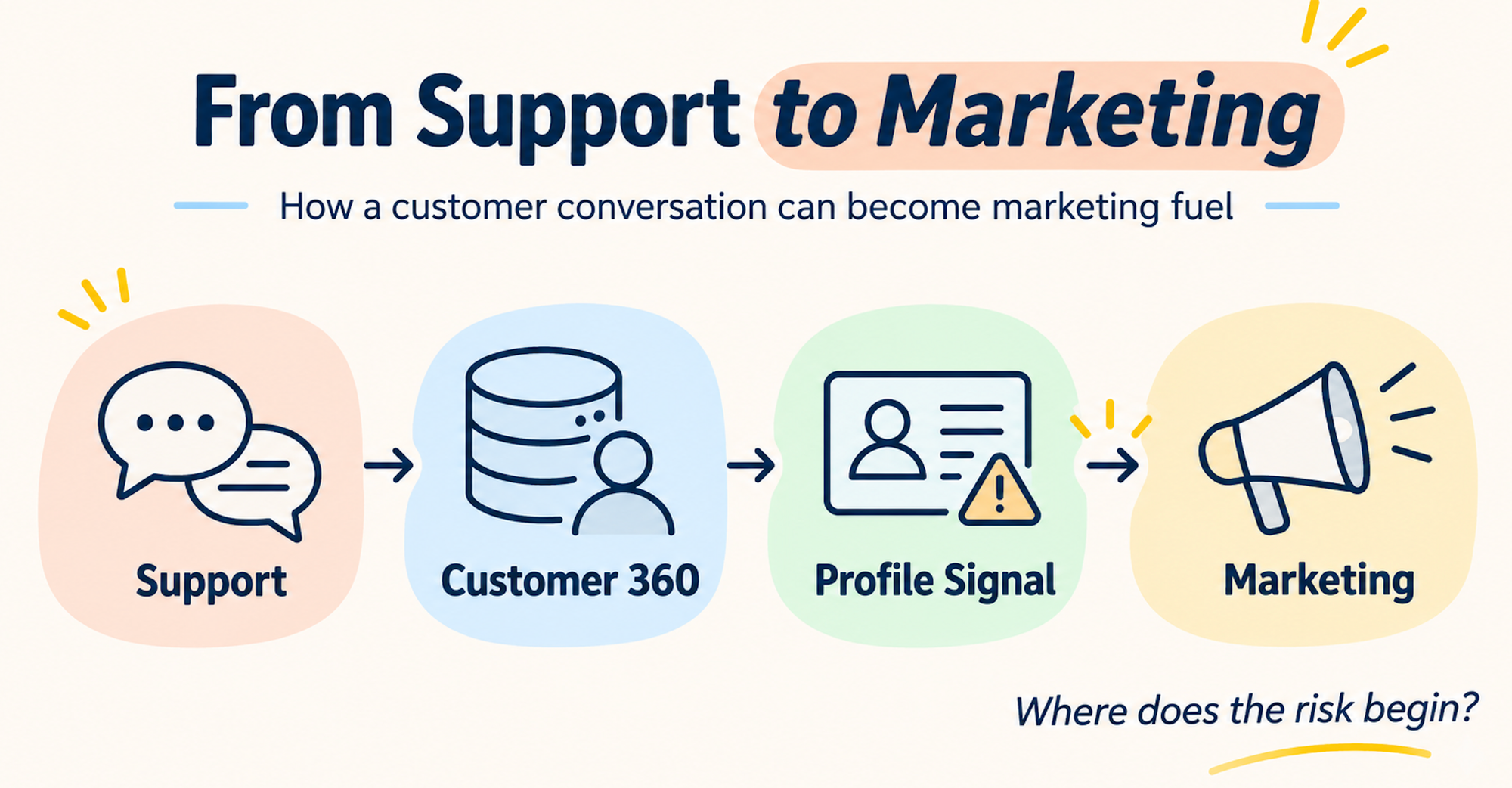
Let's call it Customer 360.
The idea sounds perfectly reasonable.
Bring customer information together from different systems so the organisation can understand its customers better and offer more relevant products and services.
Loan servicing information goes in.
Repayment history goes in.
Support interactions go in.
Marketing information goes in.
One unified customer profile.
The project has also gone through a security review.
Encryption? Enabled.
Access controls? Configured.
Logging? Enabled.
Backups? Tested.
The dashboard is green.
Everyone is happy.
But here is where our story gets interesting.
Ananya's support interaction is now part of her Customer 360 profile.
A segmentation rule identifies that she may be financially vulnerable based on the information captured during her support call.
And that segment becomes available for marketing campaigns.
Ananya contacted the company because she needed help managing her repayment.
The company is now considering using that information to decide which financial products or offers to show her.
A conversation asking for help has become a marketing signal.
No hacker entered the system.
No database was compromised.
No employee necessarily exceeded their technical access permissions.
And the system may still be doing exactly what its developers intended.
So, where is the risk?
That depends on the question we are asking.
The same system. Three different questions.
Let's look at this through three lenses.
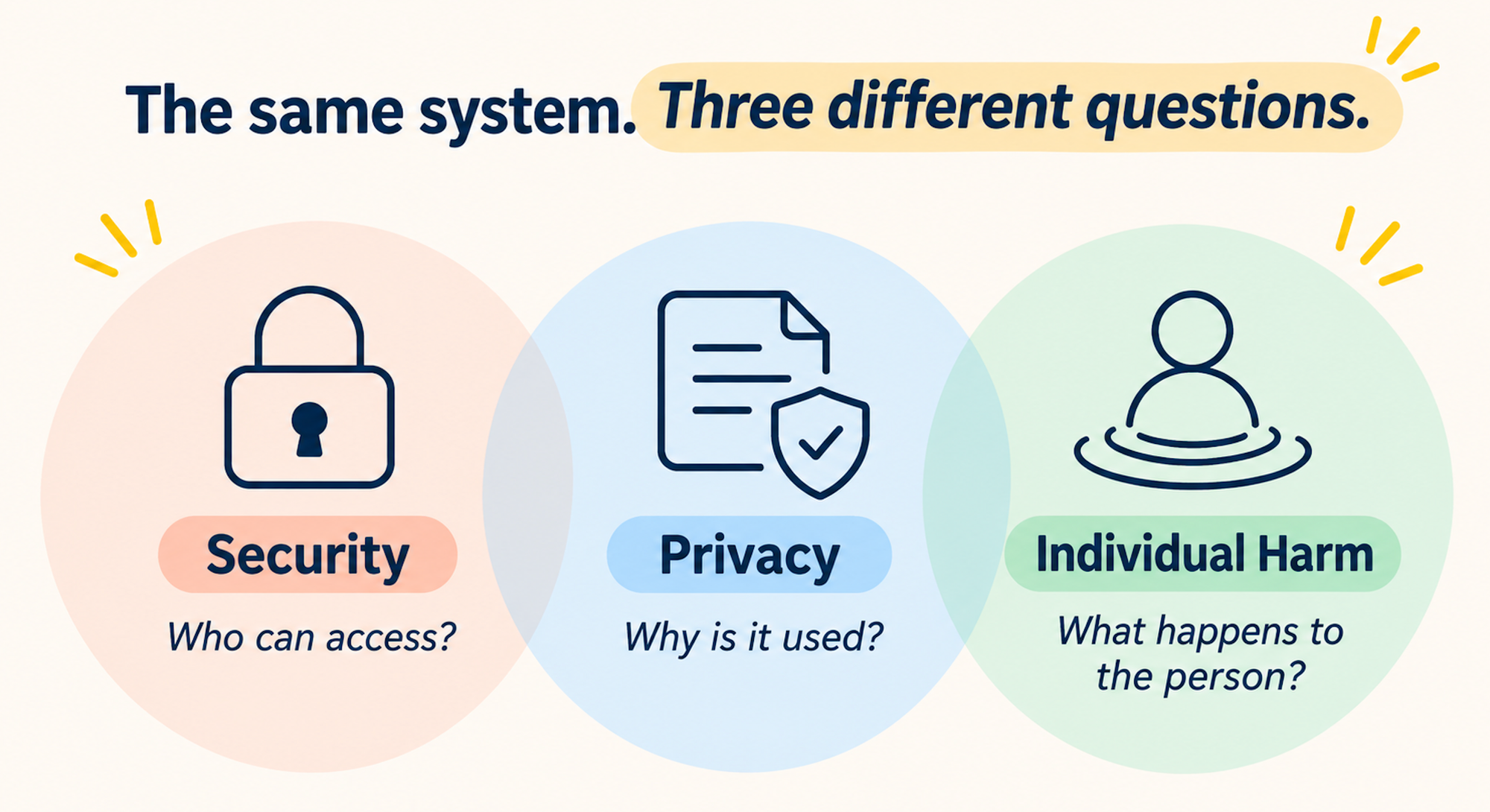
Lens 1: The security risk
The security team examines the Customer 360 platform.
Could someone gain unauthorised access to customer records?
Are permissions appropriately restricted?
Could information be leaked, altered or made unavailable?
These are important questions.
For example, if employees have unnecessarily broad access to customer financial information, that creates a security-linked privacy risk.
The cause could be excessive privileges.
The event could be access to customer records without a legitimate business need.
The consequence could be exposure or misuse of sensitive financial information.
The team might recommend role-based access, periodic access reviews and monitoring.
All reasonable controls.
But suppose those controls are working.
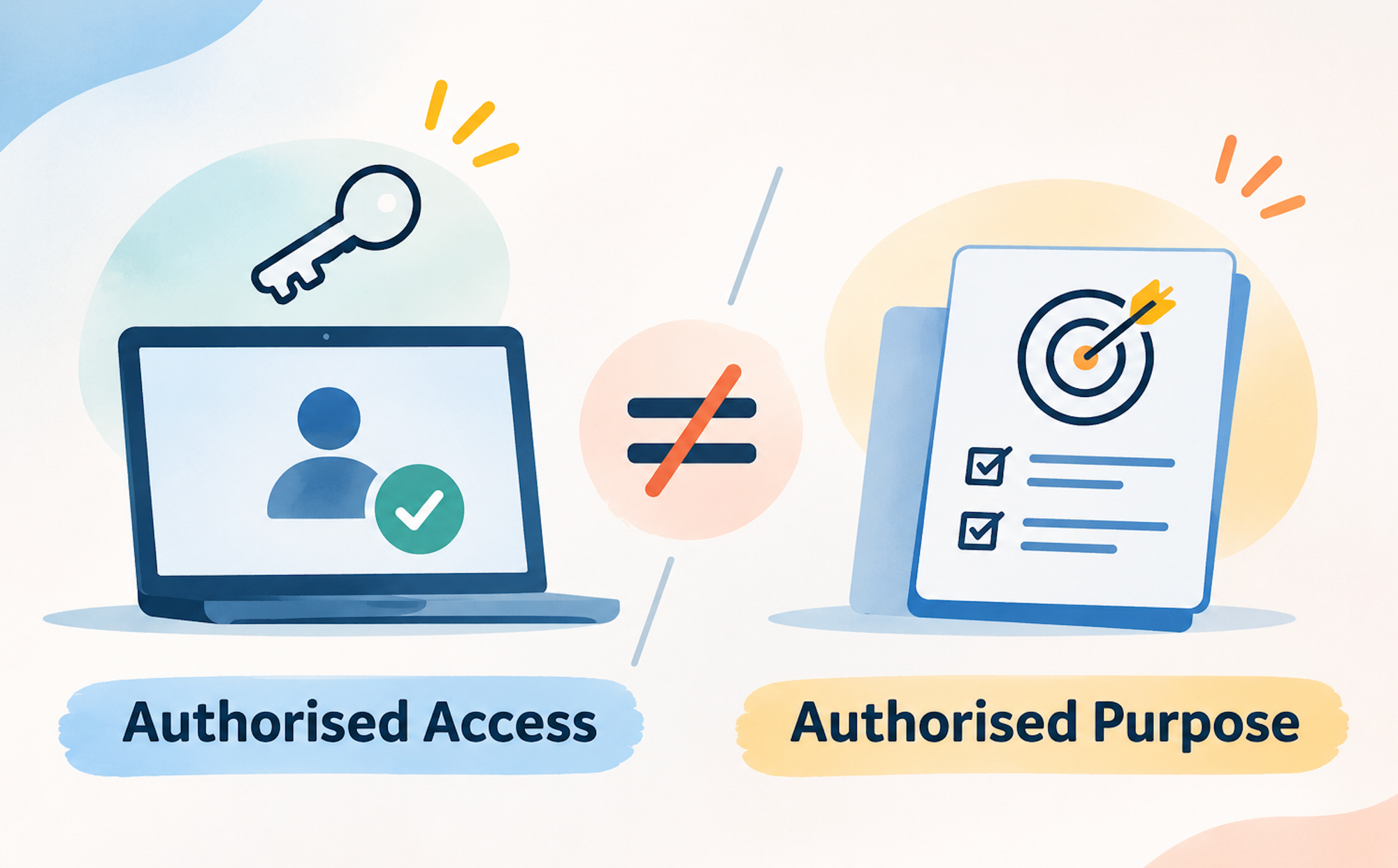
The marketing employee has valid credentials.
The system allows access.
Every action is logged.
Does that mean the subsequent use of the information is appropriate?
Not necessarily.
Authorised access is not the same as authorised purpose.
And that takes us to the second lens.
Lens 2: The privacy risk
Instead of asking only who can access the information, we now ask:
Why was this information collected?
What was Ananya told about how it would be used?
What is the justification for using support information to build marketing segments?
Is that use compatible with the original purpose, where relevant under applicable law?
Are there purpose restrictions that should prevent certain information from flowing into marketing?
Suddenly, our assessment changes.
We are no longer looking only for a failure in protecting the data.
We are examining the processing itself.
The risk is that information collected to assist a customer could be reused for marketing profiling without an appropriate legal justification, transparency or purpose controls.
That is a processing-related privacy risk.
The distinction matters.
A new use of information is not automatically unlawful. Its permissibility depends on the applicable law, the original purpose, the circumstances, and the organisation's justification and safeguards.
But that analysis has to happen.
A valid login or an approved system integration cannot answer those questions for us.
And now comes the third lens.
Lens 3: The risk to Ananya
Let's forget the systems, controls and compliance registers for a moment.
What could this mean for Ananya?
She contacted customer support because she was facing repayment difficulties.
She may not expect the information shared during that conversation to influence future marketing decisions.
Could the resulting profile expose her to intrusive targeting?
Could it steer her towards products that are unsuitable for someone in financial distress?
Could it influence the options or information made available to her?
And what does it mean when a difficult personal situation becomes an internal label used to make decisions about her?
These are potential consequences, not assumptions that harm has already occurred.
We need evidence to understand whether the pathway is credible, who might be affected, and how seriously.
But if we never ask these questions, we may never identify the risk.
This is why privacy risk assessment cannot stop at the company's compliance exposure.
The risk to the organisation and the risk to the individual are related, but they are not interchangeable.
What are we actually assessing?
This is where privacy risk assessments can become confusing.
We often use the same risk matrices we use for information security.
Likelihood × Impact.
Sometimes a 3×3 matrix. Sometimes 5×5.
I don't think the fundamental formula is necessarily the problem.
The problem is what we put into it.
Consider this risk statement:
Risk of non-compliance with data protection regulations.
I have seen variations of statements like this in risk registers.
But what does it actually tell us?
What is the processing activity?
What could go wrong?
Why could it happen?
Who is affected?
What would we change?
It is difficult to design a meaningful control when the risk itself is vague.
Now compare it with this:
Support information collected to assist customers may be reused for marketing profiling without appropriate purpose controls and justification, potentially exposing customers experiencing financial difficulty to intrusive or disadvantageous targeting and reducing their control over how their information is used.
That is a risk we can investigate.
It describes a processing event, the conditions that could allow it to happen, and the potential consequence.
It gives us something to assess.
And, more importantly, something to change.
A practical way to write a privacy risk
I like to start with three simple elements.
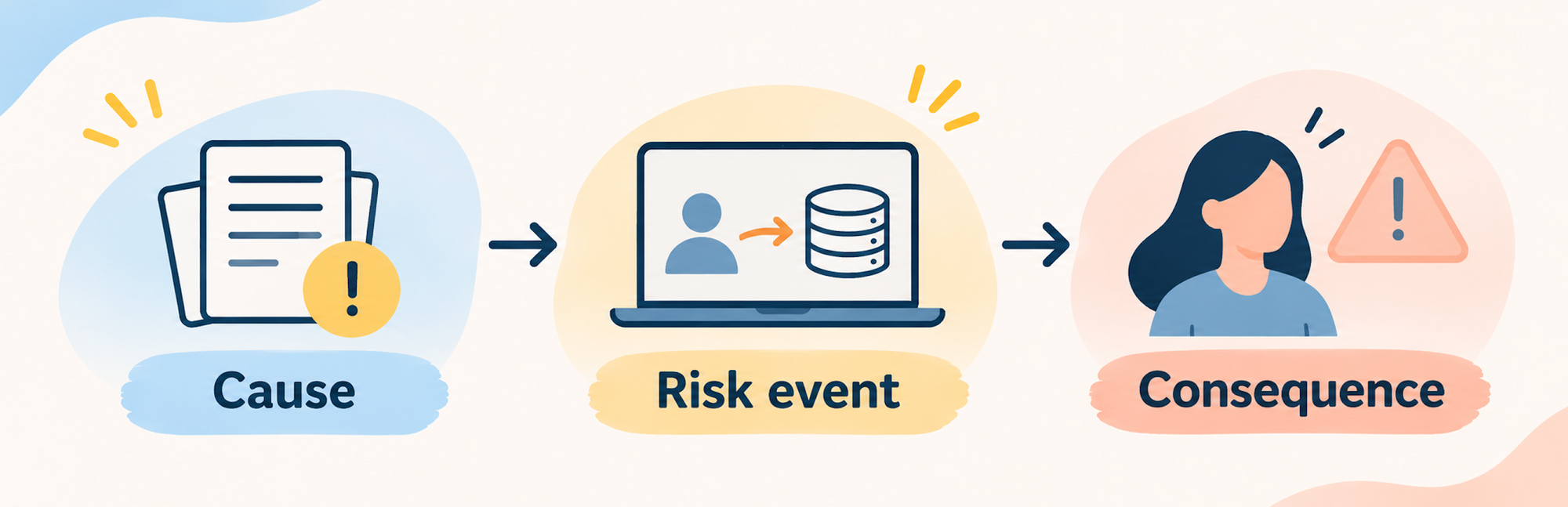
For Ananya's case:
Cause: The proposed Customer 360 architecture does not yet demonstrate enforceable purpose restrictions or an assessment of secondary marketing use.
Risk event: Support-derived information is used to create marketing segments without the necessary justification and safeguards.
Consequence: Customers may lose meaningful control over how information shared for assistance is used and could experience intrusive or disadvantageous targeting.
Notice that I haven't started with a regulation or a penalty.
I have started with the processing activity.
Once we understand it, we can identify the applicable obligations and evaluate the risks.
That is a much stronger starting point for operationalising privacy.
Now, how do we assess the risk?
Let's assume we are reviewing Customer 360 before launch.
We know the proposed architecture allows support information to flow into customer profiles. We also know the proposed segmentation rules could use that information for marketing.
But we have not yet seen evidence of appropriate purpose-based restrictions or approval controls.
We should not automatically conclude that the processing is unlawful.
We should document what is known, what is missing and what conditions must be satisfied before the system goes live.
Step 1: Establish the processing context
Before assigning a score, document the essential facts.
What information is involved?
Where did it originate?
What is the original purpose?
What is the new purpose?
Which systems and teams are involved?
Which individuals could be affected?
And what decision or action does the processing enable?
In this case, the concern is not simply that support information enters Customer 360.
The concern is the proposed use of that information for marketing segmentation.
A data-flow diagram is particularly useful here because it makes the connection between systems, purposes and downstream decisions visible.
Step 2: Assess likelihood
What exactly are we estimating the likelihood of?
For the processing-related risk, we are assessing the likelihood that unjustified or inadequately controlled secondary use will occur.
We would look at factors such as:
- Whether the data flow is technically enabled.
- Whether the segmentation rule is part of the proposed design.
- Whether the use can happen repeatedly across customer profiles.
- Whether controls exist to prevent or restrict incompatible or unjustified uses.
- Whether those controls have been tested.
For our fictional example, assume those restrictions have not yet been demonstrated.
Using an illustrative five-point scale, we might assign a likelihood of 4/5, subject to validation.
Not because every customer will suffer harm, but because the proposed design could repeatedly enable the processing event if released without additional safeguards.
Step 3: Assess impact
Here is where I would slow down.
Impact on whom?
For an organisation-facing privacy assessment, we might examine regulatory exposure, effects on customer rights and control, reputational consequences and the scale of the processing.
But we must also examine the potential impact on the people affected.
For Ananya, relevant dimensions could include:
Financial impact: Could the profiling contribute to unsuitable or disadvantageous financial targeting?
Autonomy and control: Does she understand and have an appropriate ability to exercise control over this use of her information?
Dignity: Could her circumstances be reduced to a vulnerability label that is used in ways she would reasonably find objectionable?
Opportunity: Could the profile influence the products, offers or information she receives?
These consequences require separate consideration.
The likelihood of inappropriate processing occurring is not necessarily the same as the likelihood that an individual will experience a particular harm.
Likewise, the seriousness of regulatory exposure is not a reliable substitute for the severity of the consequence to the individual.
In the workshop, I used illustrative ratings to demonstrate this difference.
The processing-related risk received a score of 15/25, based on a likelihood of 4/5 and a composite privacy impact of 3.75/5.
The individual-harm scenario was examined separately, with a likelihood of 3/5 and severity of 4/5, producing an illustrative harm indicator of 12/25.
Those numbers are not statutory scores. They reflect a workshop convention and hypothetical assumptions.
And we should not add them together.
The value is in the reasoning behind them.
What evidence supports the likelihood?
What makes the consequence serious?
What assumptions remain unverified?
Who might be more vulnerable to the outcome?
A risk score without those explanations can create more confidence than it deserves.
The risk register that should have existed
A privacy risk assessment should eventually produce a record that someone can use to make a decision.
Not a spreadsheet that simply says HIGH in red.
Here is how I would document the main processing risk in our fictional scenario.
This is a sample structure, not a universal scoring taxonomy or prescribed risk-register format.
Your organisation may use different dimensions or scales.
The important point is that the entry connects the processing, the risk, the affected individuals, the evidence and the required treatment.
And finally, what would we change?
This is my favourite part of a risk assessment.
Because this is where privacy stops being a review exercise and becomes an operational decision.
Let's return to the Customer 360 project.
Would adding more encryption solve the identified secondary-use risk?
Not necessarily.
Encryption protects data against particular security threats. It does not establish whether using support-derived information for marketing is justified.
Would adding more audit logs solve it?
Logging could help us detect and investigate use, but it would not by itself prevent inappropriate profiling.
The treatment needs to address the actual processing risk.
For example, we might require the organisation to:
Prevent: Exclude support-derived vulnerability signals from marketing segmentation by default, unless a documented assessment establishes that their use is appropriate. Implement data minimisation, purpose-based restrictions and clear approval requirements.
Detect: Monitor the actual data used in marketing queries and segmentation. Review whether purpose restrictions are functioning, not merely whether users are authenticated.
Correct: Provide a way to stop unjustified processing, remove inappropriate derived segments where necessary and handle affected customer rights and complaints.
And the project should not be approved simply because these actions appear in a mitigation plan.
Someone needs to own them.
Someone needs to verify that they work.
And the residual risk needs to be assessed before a final approval decision.
A good privacy assessment should tell the product team what needs to change and why.
That, to me, is the difference between documenting privacy risk and managing it.
So, what is the real lesson from Ananya's story?
I don't think privacy risk assessment requires us to discard everything we learned from information security or enterprise risk management.
Far from it.
We can use the same discipline of understanding the context, identifying events, evaluating likelihood and impact, implementing controls and monitoring residual risk.
But we need to broaden the questions.
Security asks whether systems, information and services are appropriately protected.
Privacy asks whether the processing of personal information is justified, appropriate and controlled.
And the individual-harm perspective asks what consequences that processing could have for people.
These perspectives overlap and should inform one another.
The purpose is not to create three unrelated assessments or three new checklists for every project.
It is to make the existing assessment more complete.
Because sometimes the most important privacy risk is not a security failure.
It is a processing activity that everyone has accepted as normal, without questioning what it could mean for the person.
The next time you review a DPIA or a privacy risk register, look at the impact rating.
Before accepting it, ask one question.
Low risk. To whom?
Because the real value of privacy risk assessment is not in how accurately we colour a box red, amber or green.
It is in whether the assessment helps us identify a consequence, challenge a decision and change the way personal data is used.
Security protects the data. Privacy protects the person.
And good governance must do both.
This article is adapted from my workshop, “Risk Through a Different Lens: Hands-on Privacy Risk Assessment.” The Customer 360 scenario and all risk scores are illustrative.
Explore the interactive workshop.